
- Insights
How do Finnish people use ChatGPT?

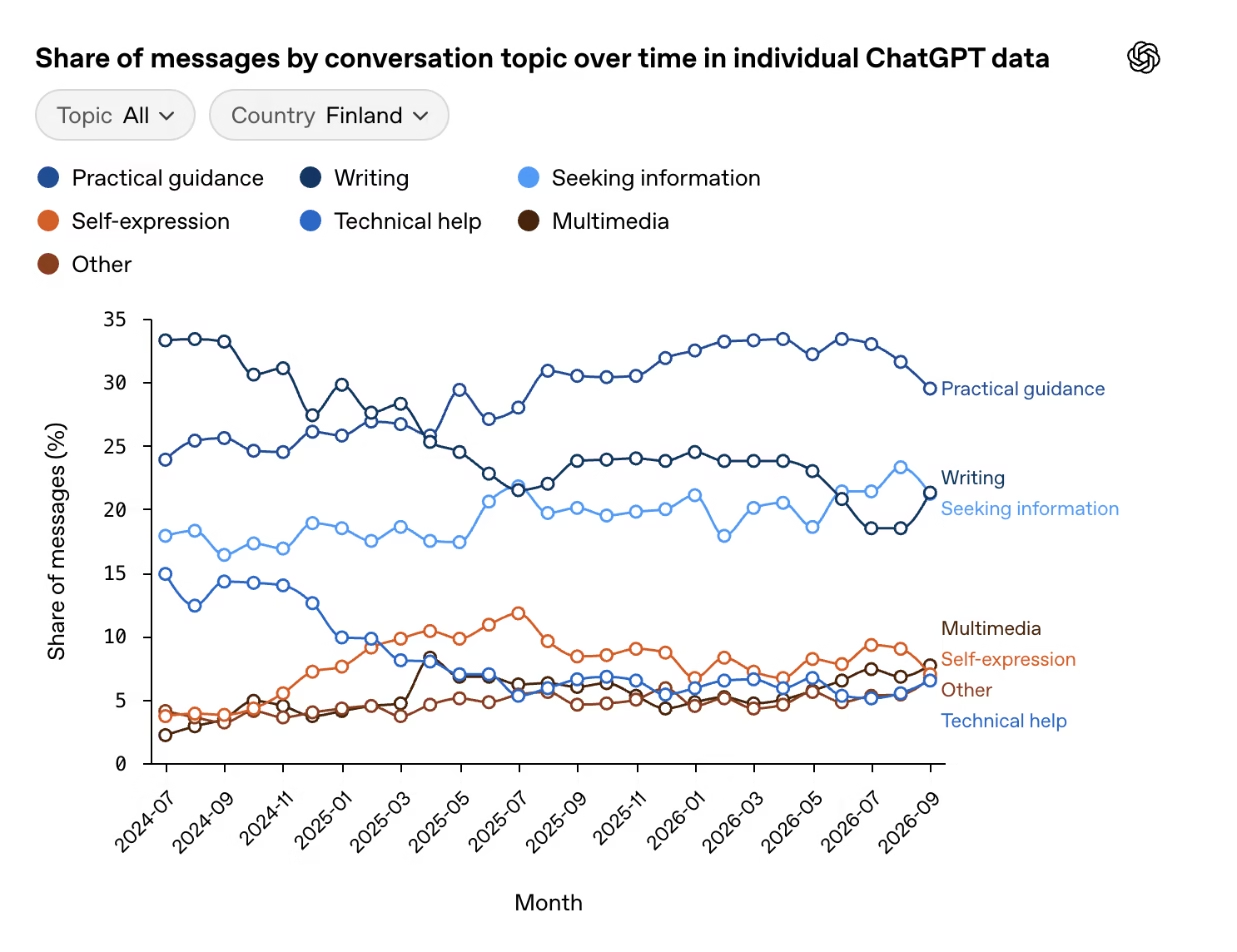
In short: Finnish people now use ChatGPT mostly for advice and for looking things up, not for writing. In September 2026, practical advice made up 29.5% of Finnish ChatGPT messages, looking up information 21.2% and writing 21.3%, according to OpenAI Signals. Two years earlier, writing was a third of everything. Outside work, ChatGPT is turning into a search engine, and that changes where your company needs to be visible.
OpenAI published a new version of its usage data, OpenAI Signals, on 26 October 2026. It covers a million classified consumer ChatGPT messages a month from July 2024 to September 2026, and it can be filtered by country. So we pulled out Finland. Here’s how Finnish people use ChatGPT, and what we think it means for marketing.
What do Finnish people use ChatGPT for?
Mostly for advice. “How do I…” and “what should I do…” questions are now the biggest use, at 29.5% of Finnish messages in September 2026, up from 23.9% in July 2024.
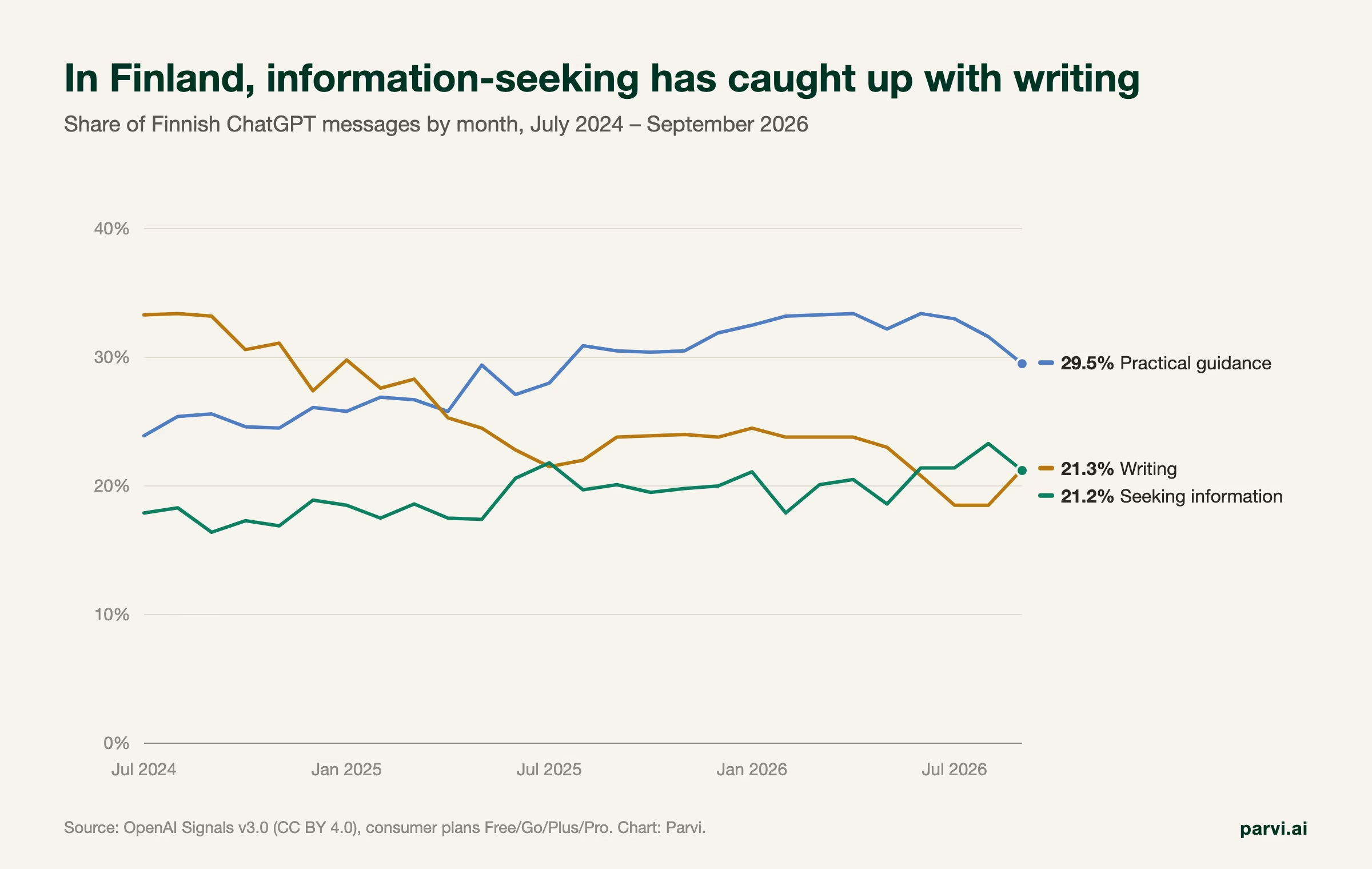
Writing went the other way. It fell from 33.3% to 21.3%. Coding help fell even faster, from 14.9% to 6.5%, but that one is probably not real: OpenAI’s data leaves out Codex, its coding tool, and that’s likely where the coding went.
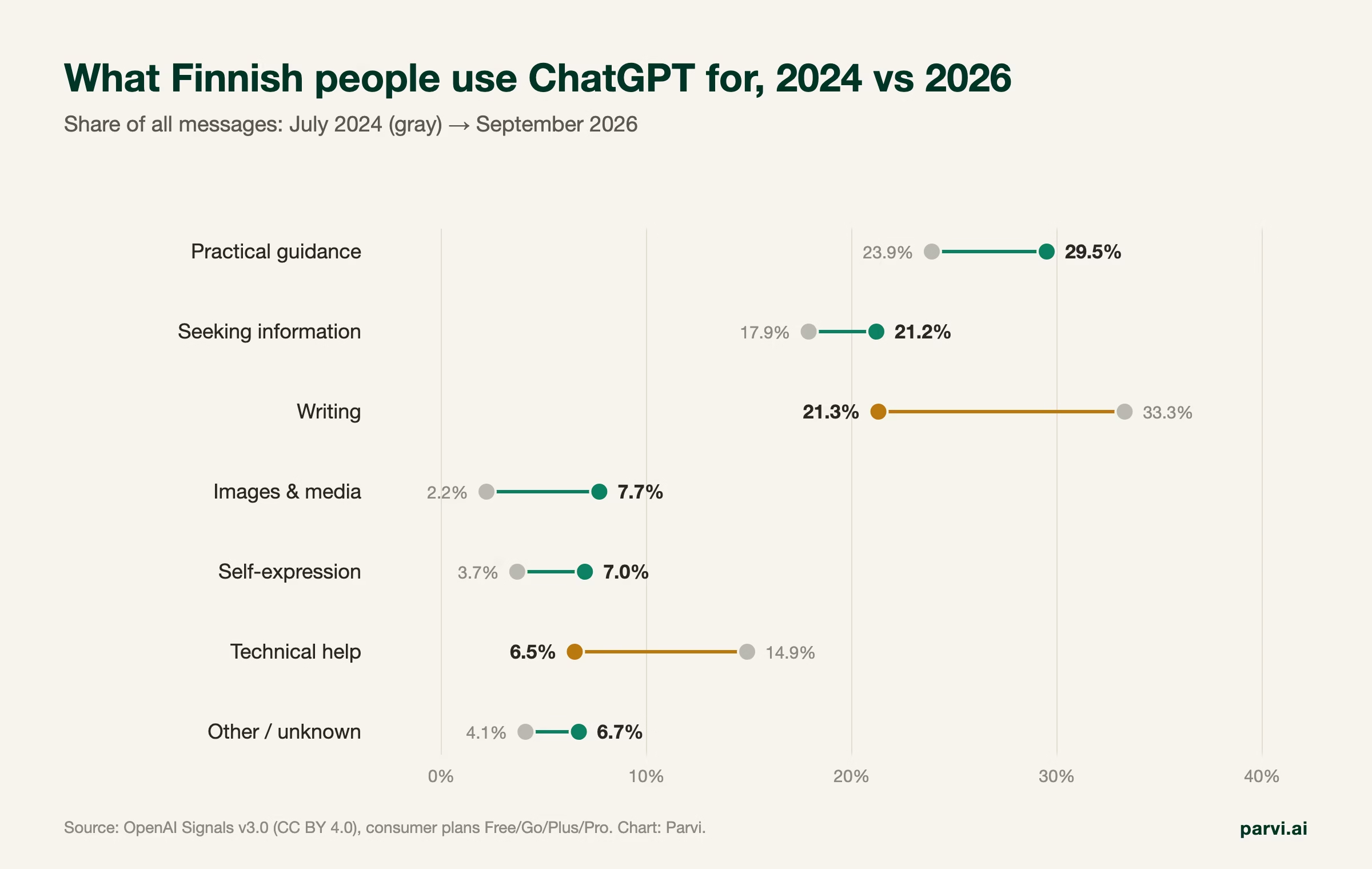
Two smaller things grew. Images and other media went from 2.2% to 7.7%. And more messages are neither questions nor tasks: greetings, chit-chat, sharing news. In personal use their share doubled, from 15.2% to 30.1%.
What counts as “looking things up”?
OpenAI calls the category seeking information. It covers three kinds of message:
- facts you’d normally find on a website: people, news, history, general knowledge
- products and services for sale (“recommend a laptop under $1000”, “how much are Nikes?”)
- recipes and cooking
Advice questions are not in it. They have their own category. And the published files don’t split the three apart, so nobody outside OpenAI can say how much of it is shopping.
Is ChatGPT replacing search?
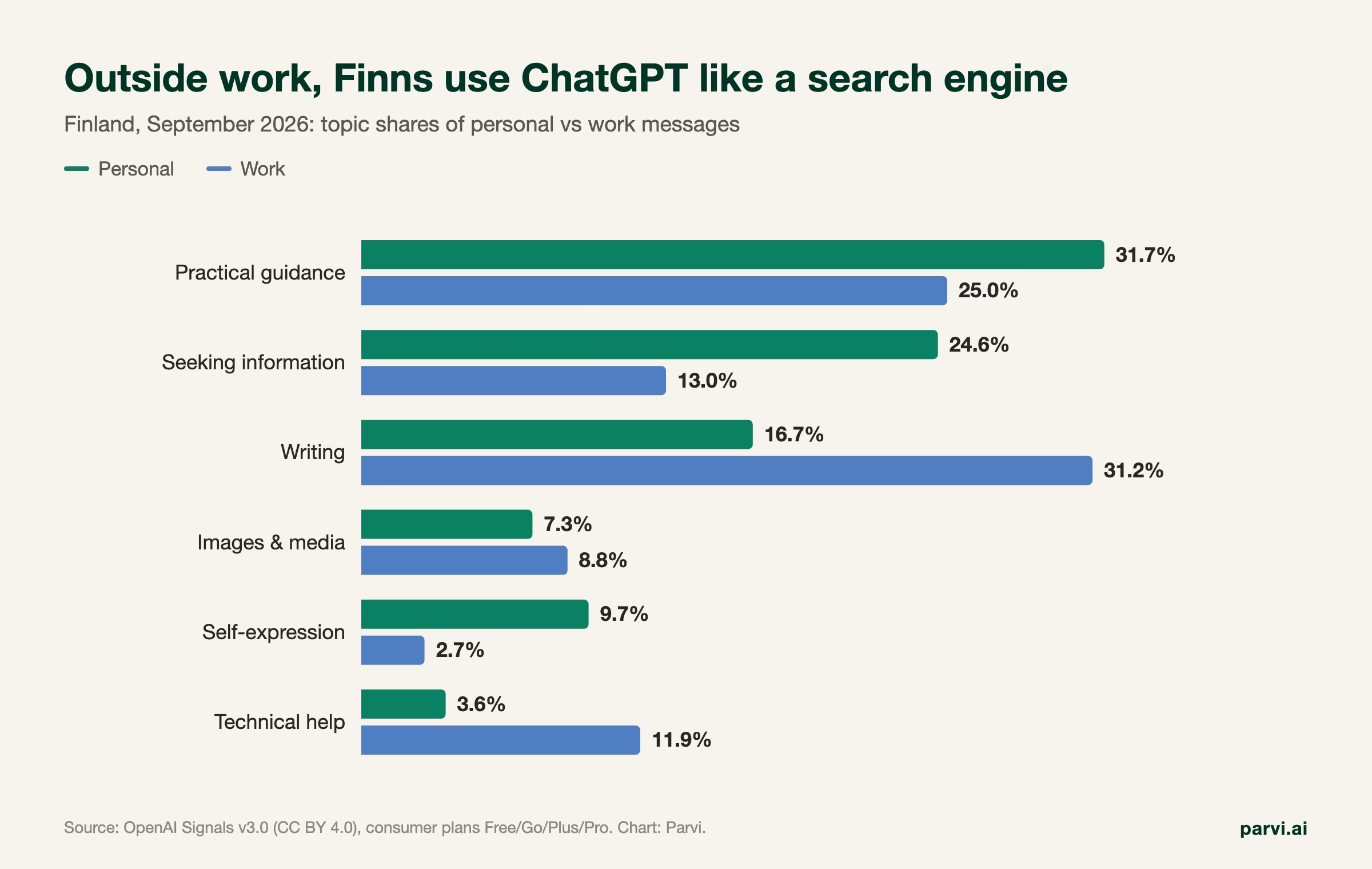
For personal use in Finland, partly. One in four personal messages (24.6%) is someone looking something up. Only 16.7% are about writing.
Across all messages, looking things up passed writing in June, July and August 2026. In August it was 23.3% against 18.5%. In September the two were level again, so we wouldn’t call it a permanent crossover yet. The direction hasn’t changed.
This is a share of ChatGPT messages, not a share of all searching in Finland. Whether Google is losing those questions isn’t in this data.
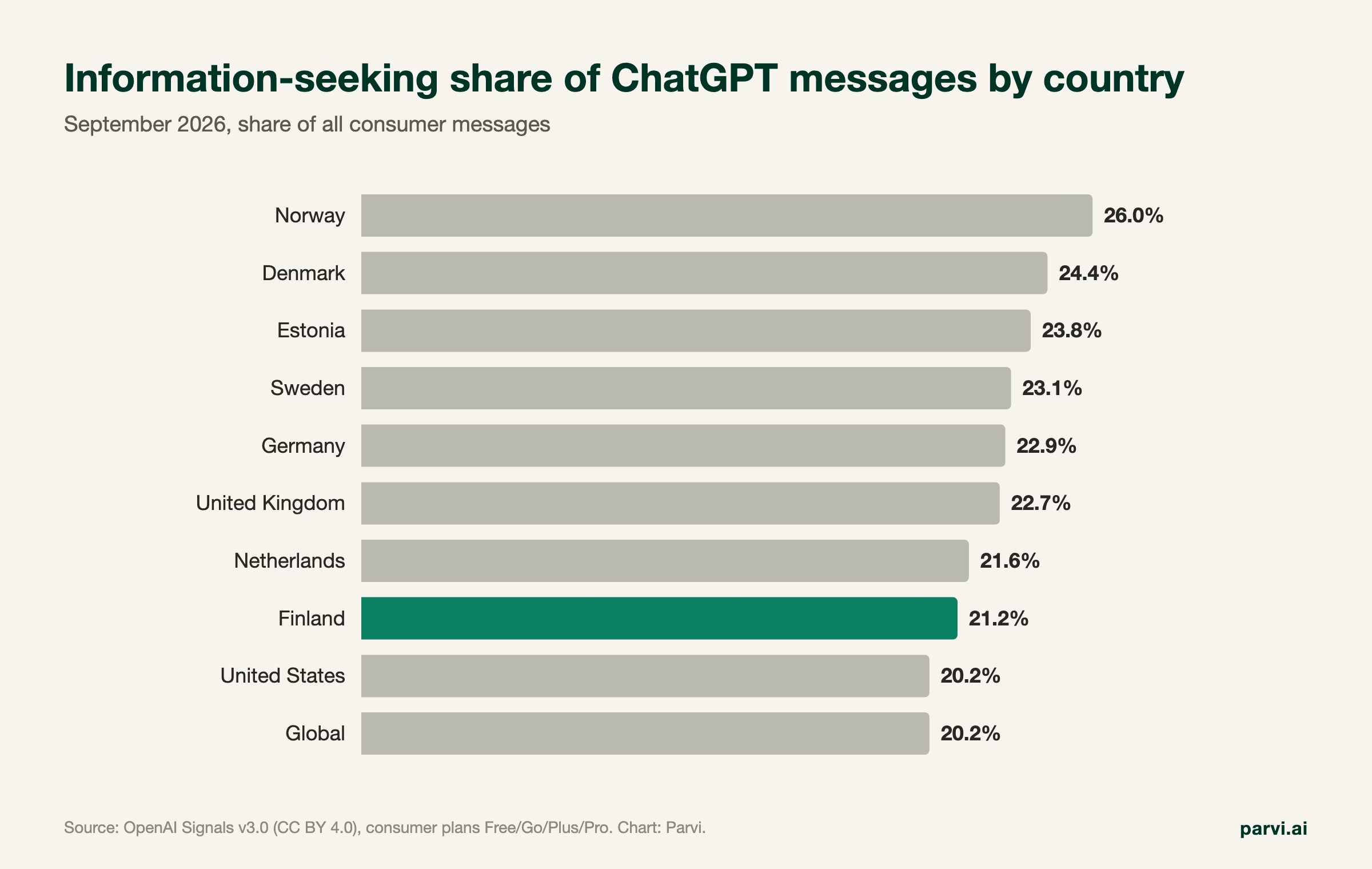
Finland is still behind its neighbours here. Looking things up is 26.0% of messages in Norway, 24.4% in Denmark and 23.1% in Sweden, against 21.2% in Finland. Finns are slower to treat ChatGPT as a search engine, but they’re moving the same way.
Search is splitting by generation
Young adults send most of the messages. In Finland, 25–44-year-olds send 58% of all ChatGPT messages. People aged 45 and over send 15%.
| Share of messages sent by people aged 45+ | July 2024 | September 2026 |
|---|---|---|
| Finland | 13.3% | 15.1% |
| Sweden | 17.7% | 22.5% |
| United States | 15.0% | 22.9% |
| Global | 10.1% | 16.1% |
Finland’s change is small enough to be noise. The clear finding is that the 45+ share grew much more in Sweden and the United States.
The 25–44 group is where a lot of today’s decision makers are, and they’re among the heaviest ChatGPT users. If your buyer is in that group, you need to show up in AI answers. But dropping Google to chase ChatGPT would be a mistake too. People over 45 send only 15% of Finnish ChatGPT messages, so for most of them Google is still where you’ll be found. How people look for information is splitting, and the split runs along generations. Your marketing plan has to cover both sides.
How much is ChatGPT used for work in Finland?
Less than before, as a share. Work-related messages fell from 46.9% to 31.0% of Finnish messages. The global figure is almost the same, 32.2%.
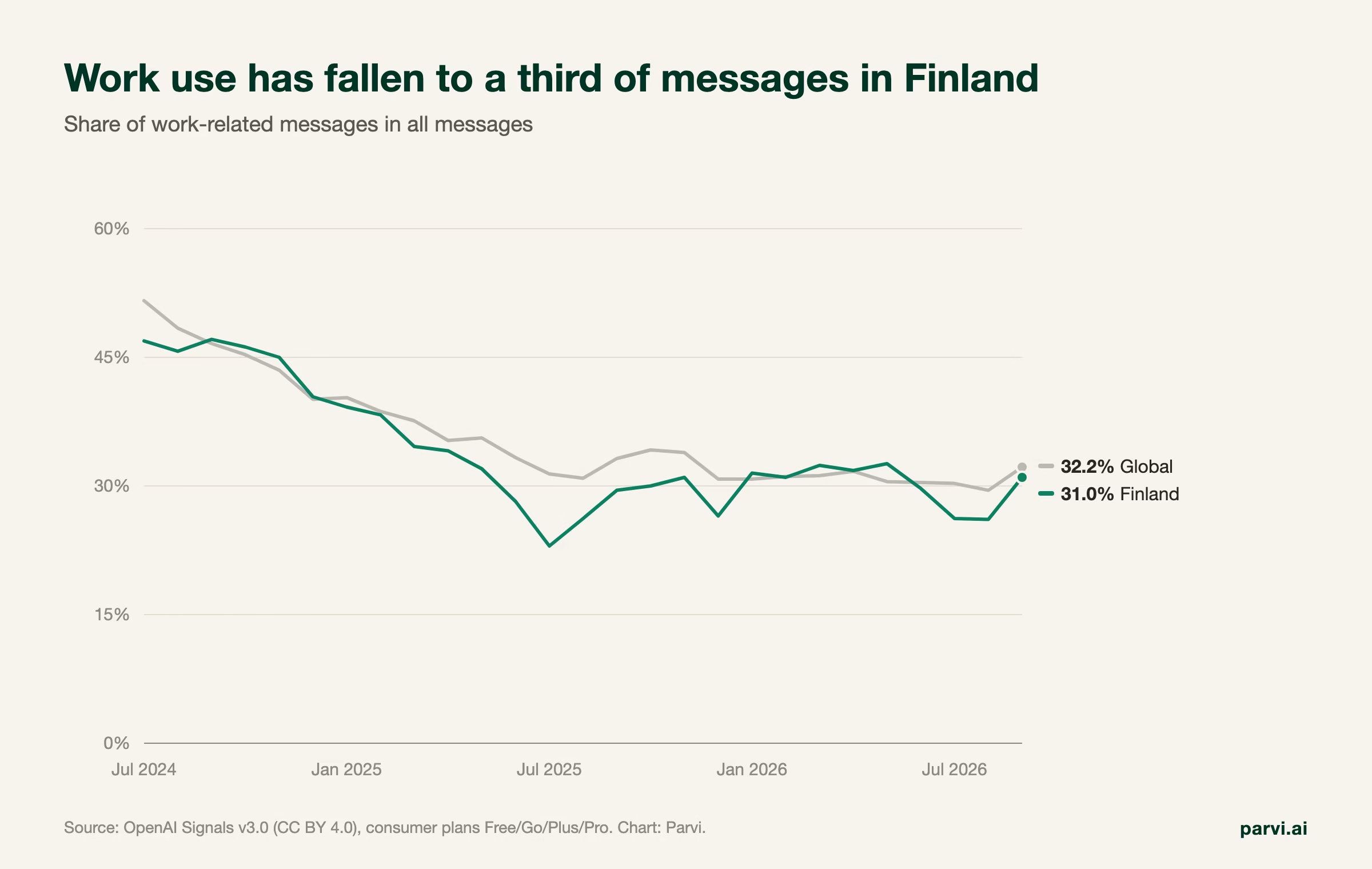
That doesn’t mean Finns use AI less at work. The data shows shares, not totals, so if personal use grew faster, the work share falls even when work use stays the same. And a lot of work AI simply isn’t in this data. In the companies we work with, work AI is often Microsoft Copilot or Claude, and ChatGPT’s own Enterprise plan is excluded from OpenAI Signals too. There are also plenty of industries where AI isn’t part of the actual work yet.
ChatGPT and buying: what it means for ChatGPT ads
The people who see ChatGPT ads mostly use it for their personal lives. Ads run on the Free plan and the cheaper Go plan, and they’ve been live in 31 European countries, Finland included, since 24 August 2026. On the Free plan, only 24.7% of messages are about work (global, September 2026). On the paid Pro plan, it’s 68.1%.
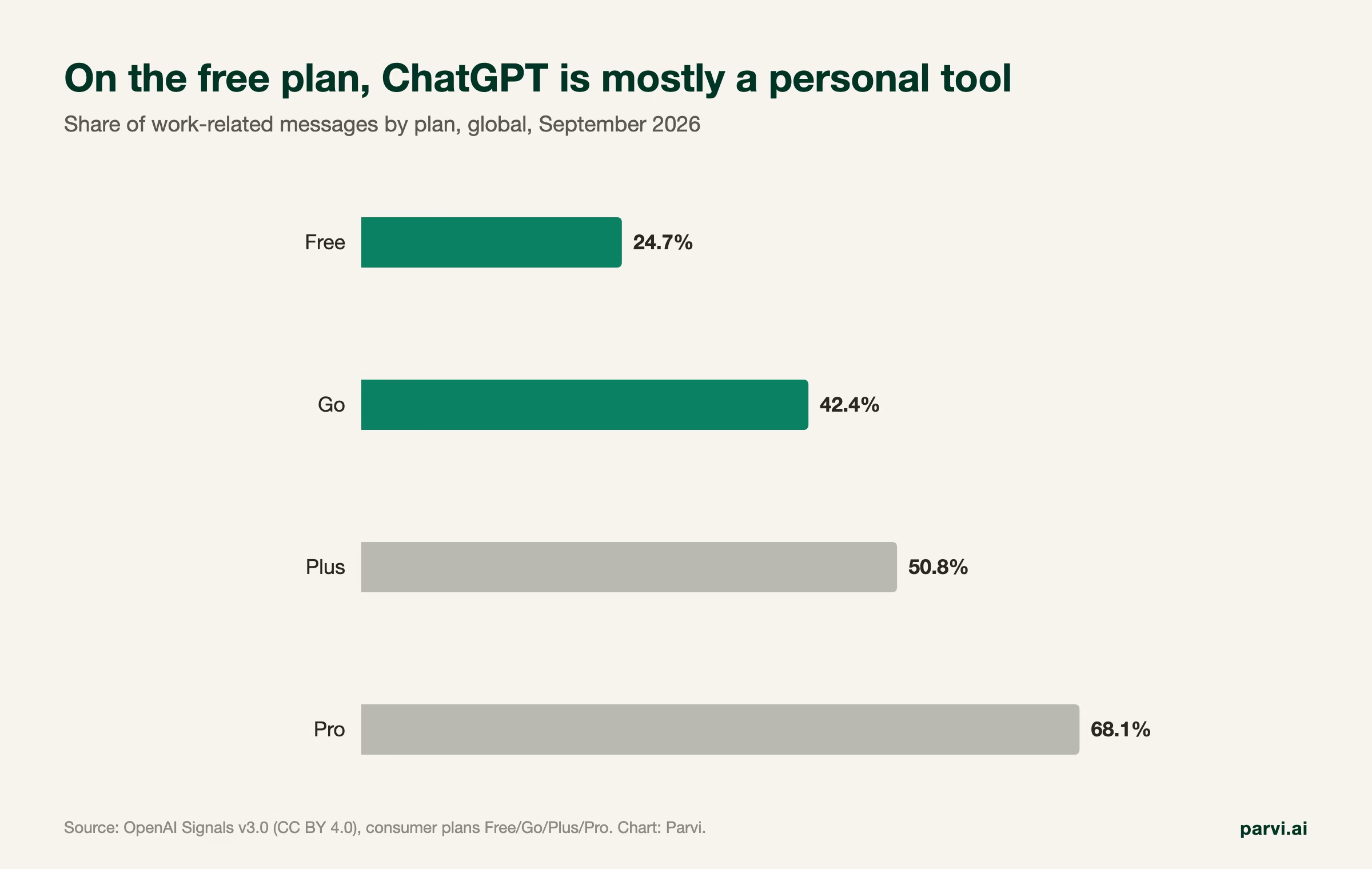
We’d compare it to Meta. Most people use Facebook and Instagram for personal things, and Meta still works as a B2B channel. The difference is targeting: in Europe, ChatGPT ads match the conversation topic, not the person. A quarter of free-plan messages being about work is a real audience. And product questions sit inside the looking-things-up category, which is growing.
If you’re thinking about ChatGPT ads, that’s the audience: mostly people asking about their own lives and purchases, with a working-hours slice on top. We wrote more about why OpenAI is starting ChatGPT ads with e-commerce.
How visible are Finnish companies in ChatGPT?
Less than in Gemini, Google’s AI assistant. In our GEO audits, we ask each AI assistant the same questions a buyer would ask and check which companies come up. GEO means getting your company mentioned and cited in AI answers. Across nine Finnish companies and about 700 questions to each of the two assistants, the company came up in roughly 40% of ChatGPT answers and roughly two-thirds of Gemini answers.
So ChatGPT is where Finnish companies have the biggest gap right now. In the same audits, the same company could be visible in one assistant and missing from the other.
We use a tool that asks ChatGPT the same questions a buyer would and records which companies each answer names, so we can see who shows up for a commercial question and who doesn’t.
If you want to know where your company stands, our AI visibility audit checks it. Our expert verifies the findings and writes the report.
What the data doesn’t tell you
OpenAI Signals shows what people ask, not what happens next. It doesn’t show which sites ChatGPT cites or what the person does next. It reports shares, not totals. It only covers consumer plans, so business use is undercounted. And country figures rest on smaller samples than the global ones, so a one or two point change in a single month can be noise. More on the dataset itself: What is OpenAI Signals?
FAQ
Mostly for practical advice (29.5% of messages in September 2026), looking things up (21.2%) and writing (21.3%), according to OpenAI Signals. Writing used to be the biggest use but has dropped by more than a third since 2024.
Mostly to get advice and answers. Most personal use is asking: how to do something, what to choose, or a fact. At work, writing is still the biggest use (31.2% of Finnish work messages).
About a third. In September 2026, 31.0% of Finnish consumer ChatGPT messages were work-related, against 32.2% globally. Enterprise plans aren’t included, so real work use is higher.
Young adults. People aged 25–44 send 58% of Finnish ChatGPT messages, and people aged 45 and over send 15%.
From OpenAI Signals v3.0, OpenAI’s public dataset of classified consumer ChatGPT messages, released on 26 October 2026 under a CC BY 4.0 licence. The charts here are Parvi’s own, built from the downloadable CSV files.
Otso Karvinen
Co-founder & Growth Strategist
I help marketing and sales teams do more in a month than their competitors do in a quarter. With 15+ years in marketing and sales, I now help build agentic AI systems that let small teams deliver faster and better results. I’m easy to work with and happy to have a no-strings conversation about where you are and how I and our team at Parvi can help.
Read more about Otso KarvinenWe’ve got a CTA for you!
Check out our pricing
Our pricing is on the site, in the open. The old agency model hides its price behind ‘let’s talk.’ We don’t need to.
Read more of
